



Men’s ice hockey coach speaks to the Quinnipiac community about his personal journey, coaching philosophy and his team’s goals and culture
November 02, 2026
November 02, 2026
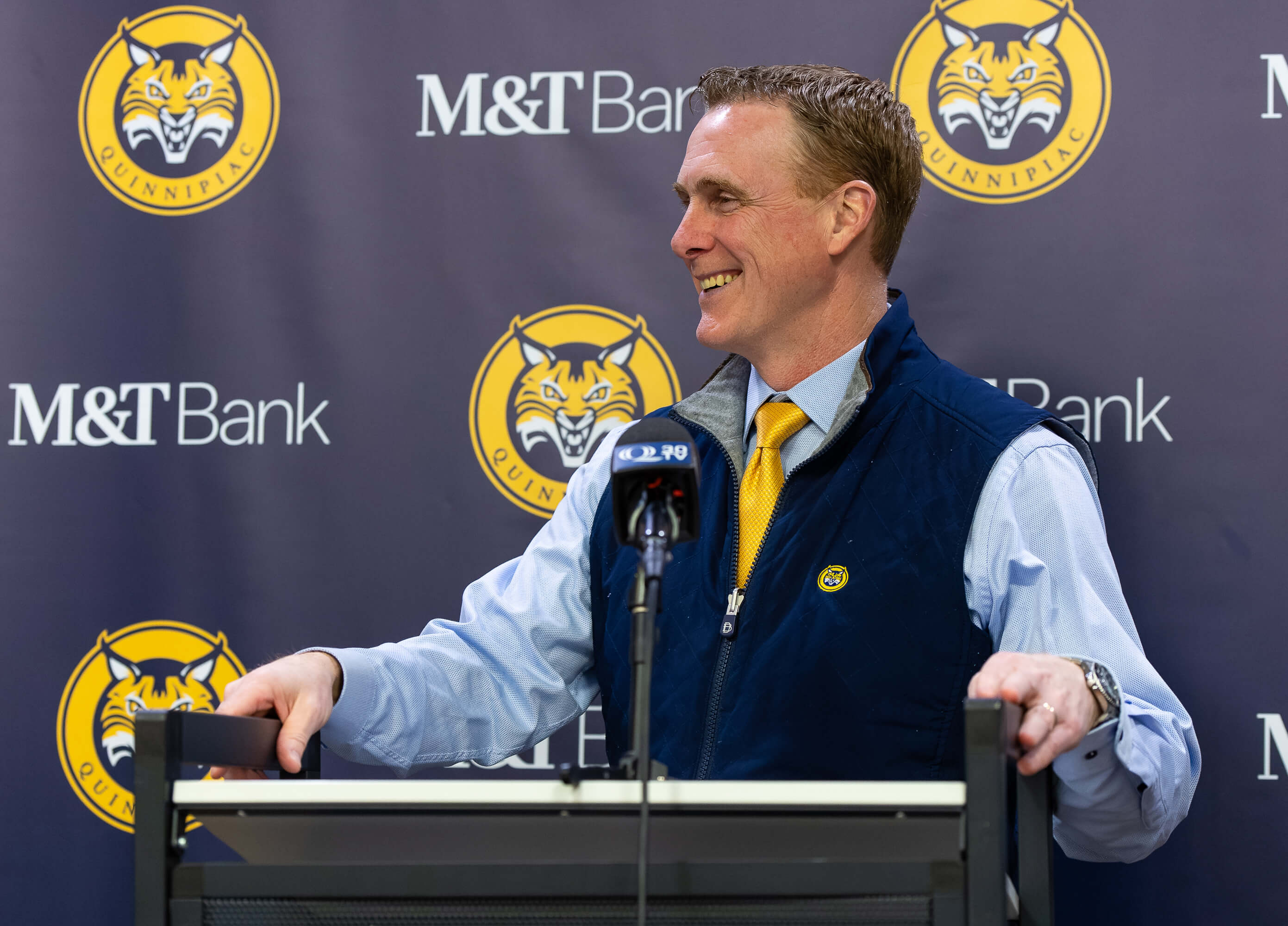
Hosted by Holly Raider, dean of the School of Business and professor of management, the event had an audience packed with energy, eager to absorb insight and ask questions. The crowd even featured the iconic banana and chicken fans, dressed for the occasion.
“It was cool to hear from a national championship-winning coach,” said Kendall Lee ‘27, a women's lacrosse student-athlete in attendance.
After being introduced, Pecknold welcomed the crowd and began by sharing some little-known background about himself and his journey.
He played his ice hockey career at Connecticut College and, at first, did not have intentions of becoming a coach. He said a graduate position after his college career is where he fell in love with coaching.
However, after completing two years as a graduate assistant, Pecknold said he was unable to get another coaching job. He then went back to Connecticut College as a volunteer coach until 1994 when he took a head coach job at Quinnipiac.
“It was a part-time job. We practiced at midnight,” said Pecknold. “I also got a teaching job, which was 71 miles away, so I lived my life in 12-hour increments, which I do not recommend. I slept 3 a.m. to 6 a.m. and 3 p.m. to 6 p.m. To top that all off, we weren’t very good. We won one game out of our first 14.”
Pecknold’s tenacity got him through these challenging times. He said that he was never going to quit.
“I was going to stay there and keep getting better,” he said. “During year two, we moved practice to 9:40 p.m.”
In 1997, the team became a Division II program, and had an outstanding season. Pecknold coached a 19-3-1 team and set a school record for winning percentage. The program moved to Division I in 1998.
“We were running in the big leagues,” he said. “If we were in the top 25, it would be great. And every now and then, we would be in there. We got better. When we were number one in the country, I realized how crazy it had all evolved.”
After speaking on his background, Pecknold jumped into some of his coaching tactics while talking about the national championship Quinnipiac took home in 2023.
Pecknold highlighted his team’s underdog mentality.
“We played in the national championship game against Minnesota,” Pecknold said. “I had two late-round NHL draft picks on my team and they had 14. The semi-final game had the same kind of odds against Michigan who had 18 draft picks.”
The Bobcats were down 0-2 early in the game against Minnesota, but they never stopped playing to win, said Pecknold.
Pecknold explained that he made a controversial decision late in the game when Quinnipiac was down 1-2 with a championship on the line.
“We were down 1-2 with three minutes, and 28 seconds left on the clock," he said.
He then asked the School of Business audience if anyone knew when hockey teams typically pull their goalie to give themselves a man-up opportunity on offense. It was then revealed that usually teams take their goalie out of the cage with about a minute and a half or two minutes remaining.
Pecknold decided to do it early.
“I am ultra-aggressive,” he said. “I felt like we needed to pull our goalie early to give my team a better chance to win. So, we pulled him in the three minutes range, which is crazy. Everybody thinks I am crazy for doing that, but since we started doing that in the last 10 years, we have a close to 40 percent success rate. So, it works.”
Pecknold showed clips of the tying and winning goals from the championship game and talked about the hard work and preparation that went into each of the plays.
“Preparation, planning and being organized is so important with anything you do,” said Pecknold. “Whether it’s as a coach, player, parent or just in your life, think about things that can happen for you and how you can affect them.”
Each play panned out exactly how the team practiced, proving Pecknold and his team’s diligence in practice and distinct coaching methods paid off.
After talking about his background and the 2023 championship, Pecknold and Raider sat down together to discuss more about Pecknold’s team and coaching style while fielding questions from the audience.
When Raider asked about effective communication, Pecknold spoke about his use of “three words.”
“The human brain, three words. That’s what resonates,” he said. “That’s what is sticky. So, I try to talk a lot in three-word sentences. Hunt the puck, attack the net — things of that nature. I don’t need to talk for an hour and a half every time I meet with them."
Pecknold tied this communication method to marketing, which hit home for students in the audience studying business.
He brought up slogans like Nike’s “Just Do It.” and De Beers’ “A diamond is forever.” Those quick phrases resonate with consumers and provide brand recognition.
“There is a lot of things that tie into marketing and advertising,” said Pecknold. “It’s about being clear and concise. Every time I meet with my team, I try to make it clear and quick.”
Raider and Pecknold moved to talking about adversity and the type of messaging Pecknold gives to his players when they face it.
“Adversity is going to come,” he said. “When it comes, we attack it with a positive manner.”
Pecknold also spoke about marginal gains and how his team uses them to inch ahead of the competition.
He said that marginal gains are small habits like getting an extra hour of sleep or wearing recovery pants after games. These tiny details add up over time.
Pecknold said he uses marginal gains himself to increase his leadership abilities. He is always trying to improve.
He gave specific examples.
“I am friends with the Chicago Black Hawks head coach, so I reached out to him and said that I was going to be recruiting in Chicago and that I wanted to come a day early and spend the day with the Black Hawks,” Pecknold explained. “He said, 'Absolutely!' So, I went in and hung out with all coaches, the general manager and it was just great to sit there and learn and get ideas from them. I think that was a marginal gain for me. I try to do one or two of those coaching exchanges every summer to make myself better.”
Pecknold also took questions from the audience, the first one coming from one of the banana-costume-wearing Bobcat superfans who was curious about Pecknold’s interest in risk management.
Pecknold explained that high-level hockey coaches often get questioned by their program managers if they take a big risk, especially if the risk does not pay off.
Pecknold gave credit to the supportive nature of Quinnipiac, which supports his aggressive, risk-taking coaching style.
“If you do something like pulling the goalie early and the general manager doesn’t agree, you can take heat from them, your fan base,” he said. “One of the best things about being at Quinnipiac is that I have had 30 years of athletic directors who have supported me."
Raider built off Pecknold’s discussion by bringing up how students entering the workforce do not always pay attention to the qualities of their supervisor when job searching. They instead focus on location and salary.
Raider wanted Pecknold’s perspective on which qualities make a good supervisor, and how important it is to have a good connection with one’s future boss.
“You want to have a great boss who is also a great mentor,” said Pecknold. “They should teach you, make you better and allow you to flourish.”
Pecknold also spoke about building his team’s culture when Raider asked about his team’s ethos.
“The number one thing is to recruit high-character kids because those great kids are going to be selfless, not selfish,” he said. “Selfless players are going to help you win games. They’re going to do whatever it takes. They will make sacrifices all over the rink."
Pecknold spoke highly of his team’s character, further diving into player accountability. While fielding a question about playing well no matter who the competition is.
“On good teams, coaches hold players accountable. On great teams, players hold players accountable,” said Pecknold. “You need great player accountability if you are going to be great."
He said each player on his team acts as an equal, furthering the team’s strong culture and bond.
“It is hard to hold each other accountable on a team because they are your friends, but that is something that we teach,” he said. “Here is a random thing that happened yesterday at practice: we sometimes must clear the ice in the middle of practice because it gets too snowy. In the old days, the freshmen had to pick up the pucks. I looked down the ice, and I see my junior captain, my senior captain picking up the pucks. It was awesome. As a junior, senior leading on your team that increases your culture and belief in one another.”

Want to learn what Quinnipiac is all about? We invite you to join us at an Open House, where our students, faculty and staff will introduce you to life as a Bobcat through a variety of sessions and tours.














Quinnipiac Today is your source for what's happening throughout #BobcatNation. Sign up for our weekly email newsletter to be among the first to know about news, events and members of our Bobcat family who are making a positive difference in our world.
Sign Up Now